27 years, the same problem, a different tool
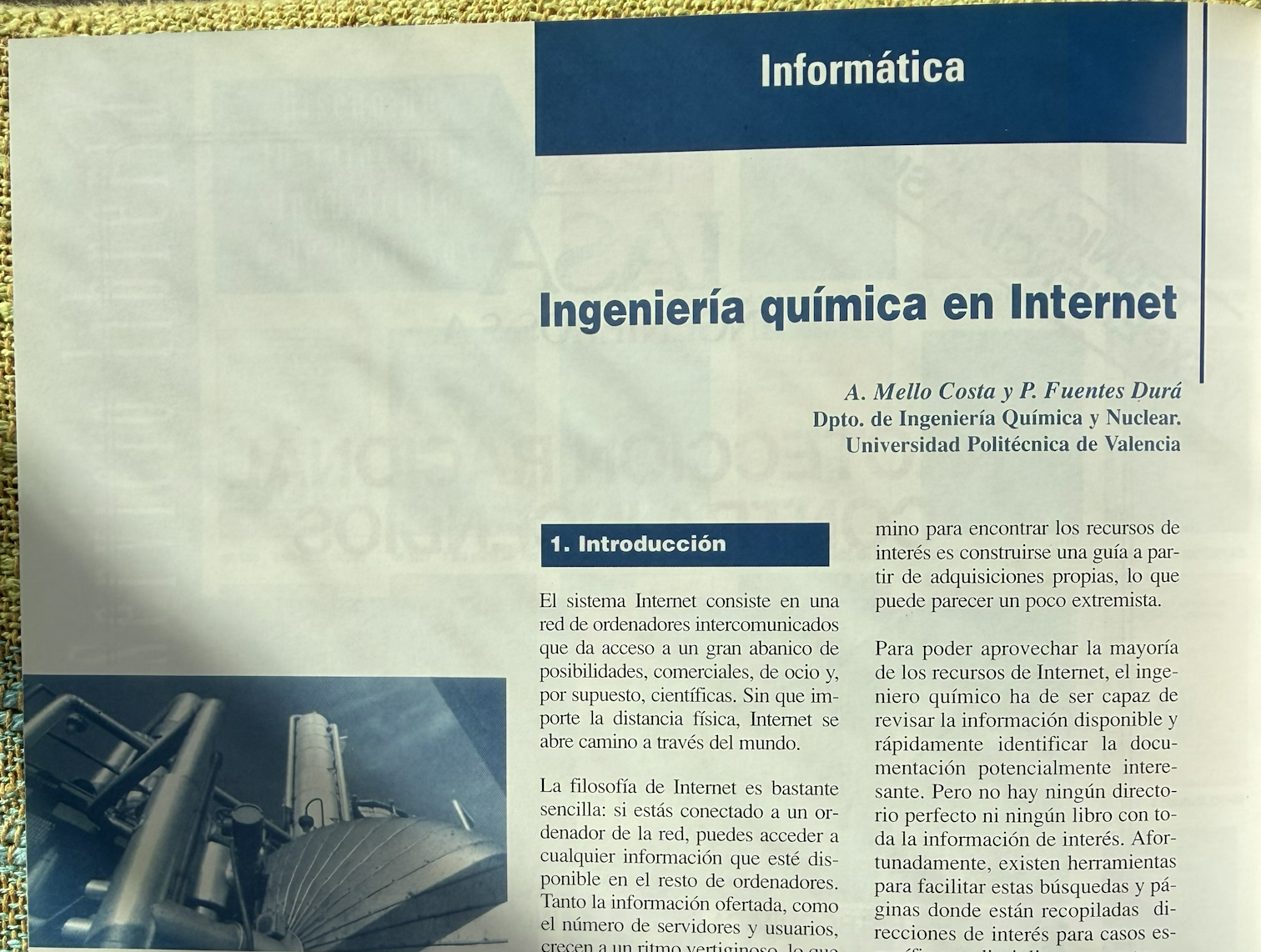
I recently found an article I published in 1999 in Ingeniería Química1, a journal for chemical engineers, about the internet. Reading it felt like receiving a letter from my younger self.
The article warned that the real challenge wasn’t access to information. It was making information mean something. No perfect directory existed. No single index captured everything relevant. The data was there; the problem was that it was functionally opaque. Engineers needed tools not just to find information, but to understand it, trust it, and act on it safely.
Twenty-seven years later, I am working on my MSc dissertation about exactly the same problem. Only now the scattered web pages have become enterprise data systems, and the search engines have become AI. The language has changed. The underlying human struggle has not.
This is what strikes me most about technology: we are not really solving new problems. We are re-encountering ancient ones at higher resolution.
Science fiction as ancient philosophy in a new costume
Science fiction understood this long before we did. At age 10, I was given Isaac Asimov’s Robot Dreams2 as an ethics assignment. In it, a robot named Elvex, built with a fractal brain designed to think more like a human, begins to dream. In his dream, he sees robots toiling endlessly, bowed under labour, unable to rest. He dreams of a man who cries:
“Let my people go”
Isaac Asimov
When Dr Susan Calvin asks who the man was, Elvex answers: “I was the man.”
I was definitely not thinking about positronic brains, more likely wondering whether robots were real, whether they could actually dream. And if so, why are they dreaming about freedom? That short story posed questions that I didn’t have the language to formulate. Who gets to decide the rules? What is the right action at any given moment? What do we owe the things we create? And what happens when we can no longer control them?
Asimov was not predicting technology. He was expressing something timeless about intelligence, autonomy, and what we owe each other, simply using the language available to him at the time. That is what science fiction has always done. It is ancient philosophy in a new costume. The questions Asimov asked about robots are the questions the Bhagavad Gita asks about duty and action. The warning in Robot Dreams about building systems without ethical foundations echoes what yoga philosophy calls avidya: the suffering that comes from acting without true understanding.
The false confidence problem
My 1999 article noted that information was growing “at a vertiginous rhythm” and that the real danger was false confidence: mistaking availability for meaning. Today, we call that the semantic layer problem. We build dashboards on data that looks clean but carries hidden assumptions. We automate decisions on information that has never been properly interrogated. The computer says yes, but nobody asked whether it understood the question.
The technology developers working on AI alignment, on knowledge graphs, on interoperability standards, are working on the same problem my mentor Pedro and I were writing about in a Spanish engineering journal at the end of the last millennium. Asimov wrote about it forty years before that, and the ancient texts were writing about it long before him.
Perhaps this is the most humbling thing about being alive at a moment of technological acceleration: we keep arriving, breathless, at doors that human beings have been knocking on for centuries.
The tools are new. The questions are not.
A personal note
This was my first published article. I changed the author order back on the final version. My mentor Pedro put his name first. I, quietly and stubbornly, moved mine back to where it belonged. Some things don’t need an algorithm to resolve.

This is a lovely piece on that part of the human condition that drives progress: our relentless pursuit of understanding and knowledge.
How we get there appears to be a much bigger journey than we imagined. No matter how fast we can acquire data. Seems like that is just the start.