The double edge of AI in Knowledge Management
I keep a lot of knowledge in my head. Not on purpose, and not because I’m precious about it: it’s just hard work to get it out. Explaining something I know well, in a way that actually transfers, takes more effort than doing it myself. So it stays where it’s easiest to keep it: in my head, applied quietly, rarely written down.
I’ve been thinking about this a lot lately because I’m in the middle of a training and documentating campaign at work, and I’ve started using AI to help me get that knowledge out. I run a training session live, working through real examples, questions, and edge cases as they come up. The recording/transcript is feed into AI with a template and a few prompts with a brief. The first draft is created the trainee refines the document. We then review it together. It’s changed how I think about an old framework I have met through my MSc: Nonaka’s SECI model1.
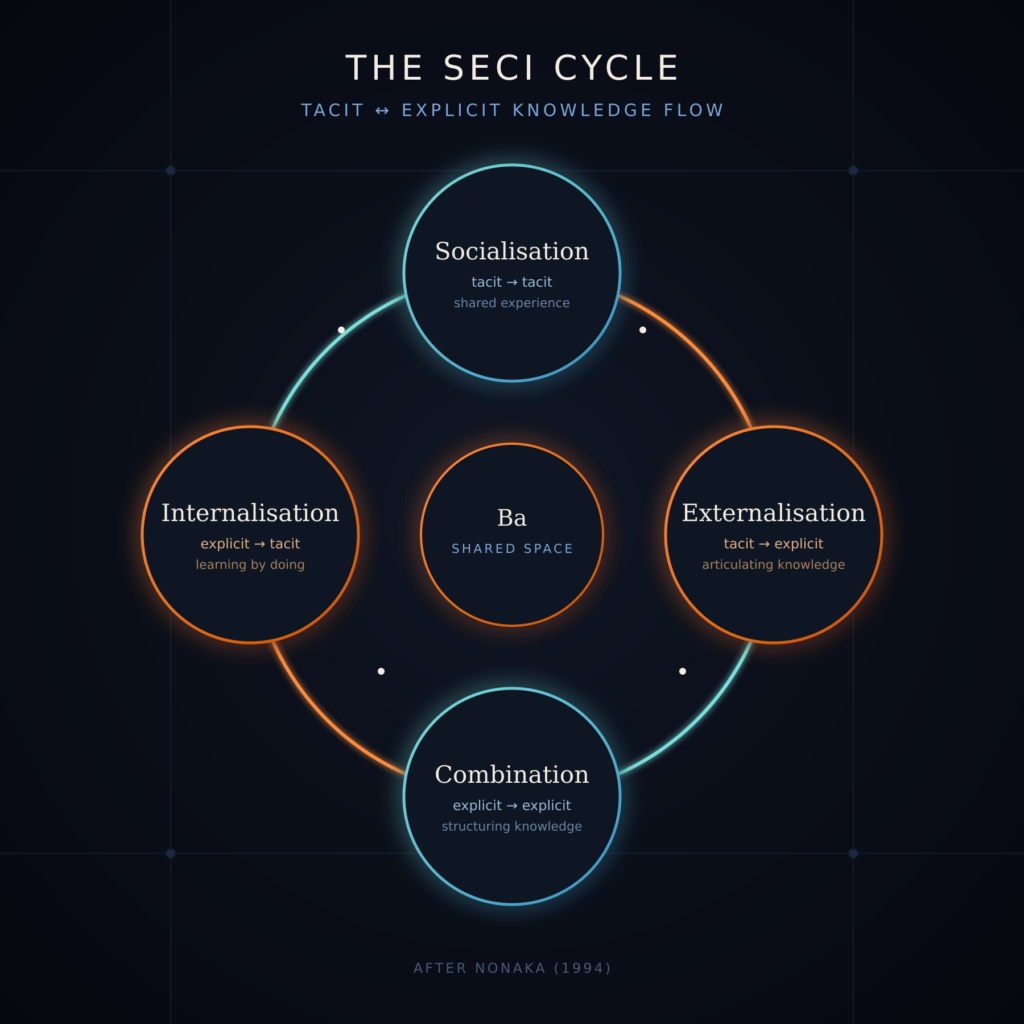
A quick map: SECI
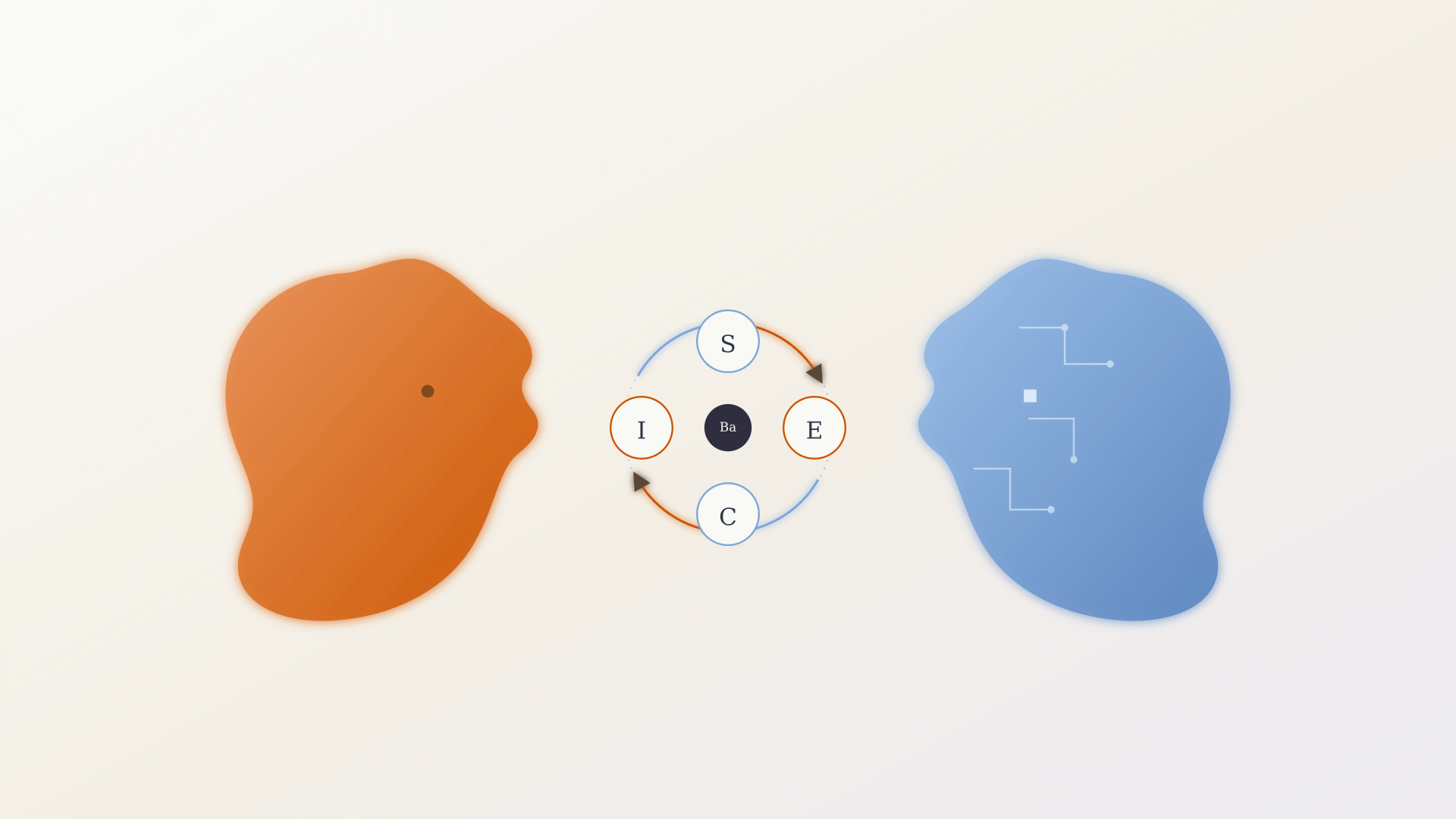
SECI is a model of how organisations turn tacit knowledge — the stuff we know but rarely say — into explicit, shared knowledge, and back again. It moves through four modes:
- Socialisation: where tacit knowledge passes between people through shared experience, no words needed;
- Externalisation: where someone puts tacit understanding into words or diagrams for the first time;
- Combination: where separate pieces of explicit knowledge get organised into something more structured; and
- Internalisation: where explicit knowledge gets absorbed back into someone’s own tacit practice, through doing.
Nonaka proposed this in the early 90s, and it’s held up remarkably well as a way of describing where knowledge creation actually happens in a company. However, it was built in a world of physical proximity: shared rooms, shared shifts, a mentor looking over your shoulder. It didn’t anticipate generative AI, and it didn’t anticipate a pandemic that would empty out the rooms it assumed existed.
Where the model gets tested
Many studies tested the model, I found two pieces of research particularly interesting. One is a study published in Frontiers in Psychology2 that set out to test whether SECI’s four modes were actually measurable in real organisations, rather than just a tidy theoretical story and found that they were, and that each mode connects to different outcomes like performance or innovation. The other3 looked at software developers, and found something messier: the four modes don’t move in a neat cycle the way the classic diagram suggests. Developers jump around, sometimes skipping straight to externalisation through tools like code review and version control, without going through socialisation first.
That difference makes sense to me. Software development is inherently iterative: after the initial plan, you’re constantly reviewing, rewriting, testing against where you’re trying to get to. A lot of other industries, including the manufacturing world I came from, tend to capture tacit knowledge once, in a procedure or a process map, and then leave it sitting until someone updates it. Iteration seems to force SECI’s transitions to happen constantly rather than in careful sequence.
Then AI arrives
What’s newer is a framework called GRAI, proposed this year by Böhm and Durst4, which revisits SECI specifically for generative AI. Their argument is that AI’s biggest impact lands on externalisation: the step that’s always been the hardest and slowest, because it requires someone to sit down and deliberately articulate what they know. AI tools, especially transcription and summarisation, largely automate that. A recorded conversation becomes searchable, structured text almost as a byproduct, not as separate effort.
This is exactly what I’ve been doing without quite naming it that way. Here’s the part I find genuinely interesting: in my case, externalisation and socialisation aren’t happening as two separate steps. They’re happening in the same session. I record a training conversation, AI turns it into a first-draft document, and then the person I’m training and I sit down and go through it together. Here is the iteration loop: question it, correct it, add to it. The socialisation: the live, human, question-asking part; isn’t lost to the AI step. It’s folded into it. There’s just, now, a record of it.
I’m not sure how most people are using these tools, I don’t think it’s automatic. I find teaching someone easier than writing something down alone: explaining out loud, to a real person who can push back, is just a more natural way for me to surface what I know than staring at a blank document. The AI isn’t replacing that instinct. It’s giving the output of that instinct somewhere to go.
The part that worries the researchers
The same research that’s excited about externalisation is honest about what it risks. The GRAI framework, and the papers responding to it, flag that generative AI can reduce human socialisation and marginalise junior colleagues in particular: when a transcript and a summary appear instantly, there’s less pressure to have the slower, informal, face-to-face exchange where trust and the harder-to-name parts of understanding actually get built. One paper puts it more starkly: if a machine ends up carrying too much of the exchange, the people who come after may only ever inherit the explicit residue the AI produced, not the tacit, embodied knowledge behind it.
There’s a subtler warning too, from a paper proposing a related “GenAI SECI” model5: AI-generated knowledge isn’t self-grounding. Someone still has to connect it back to lived experience for it to become real, internalised understanding. Otherwise what you have is just text — organised, searchable, and hollow.
The other modes: combination and internalisation
So far this is really a story about the first two modes. But a comment I heard recently pushed me into the other two: “when will AI become better than us at making meaning?” The person asking it, I think, was pointing at combination: the mode where separate pieces of explicit knowledge get organised into something new. On raw combination, AI arguably already is better than us: it can recombine vast amounts of existing explicit knowledge faster and more broadly than any person could.
I don’t think the apparent limit on AI “making meaning” is a combination problem. It’s an inherited externalisation problem. Combination can only work with what’s already been made explicit: it has no access to tacit knowledge that never got articulated. So when AI-assisted combination feels hollow, the gap usually isn’t in the recombining, it’s in what never made it into the input. From my work on semantic interoperability: systems can exchange data perfectly and still not mean the same thing, because meaning depends on context that was never made explicit.
Internalisation is trickier, because it’s the mode most tied to being human: explicit knowledge folding back into tacit practice through doing, in a specific embodied context. Training comes closest to an AI equivalent: a model absorbs a vast body of explicit material and compresses it into weights that aren’t stored as retrievable facts, which is very tacit-knowledge-shaped. But the analogy breaks on grounding. Human internalisation happens through repeated, consequential action in a context that’s specifically yours: the same instruction lands differently for different people, and right action can only be judged from inside that context. A model’s “doing” during training is exposure, not stake; it has no context of its own it’s acting within. What looks like internalised judgement is really a sophisticated reproduction of judgements humans already externalised somewhere in its training data.
Same limitation, both times: context that was never made explicit, and that AI has no independent way to go and acquire for itself.
When the shared space is virtual
This lands somewhere bigger than knowledge management frameworks. Almost five years since the pandemic forced a huge, involuntary experiment into remote work, and a lot of organisations are now pulling people back to desks, sometimes reluctantly on both sides. I don’t think proximity alone rebuilds what got lost. Socialisation was never really about scheduled meetings: it was the conversation by the coffee machine, someone leaning over your desk, the thing you only mentioned because someone happened to be standing there. None of that comes back automatically just because a badge swipes into a building. It has to be designed for, deliberately, or it doesn’t happen at all.
I suspect that’s true outside of work too. We’re still, collectively, working out how to interact virtually and can/should move online, what still needs a room and a body in it, and what we lose when we stop noticing the gap.
Carrot and stick
So this feels like two sides of the same coin. The carrot is real: AI can capture and externalise knowledge that used to just evaporate once a meeting ended, and it can do that in a way that fits how some of us actually think and teach best. The stick is that this can’t be left to happen by default. If organisations and individuals don’t deliberately protect the human unrecorded side of knowledge sharing, they’ll lose it quietly, not through any single bad decision, just through drift.
The answer is not to be wary of the tools but to notice what they’re good at, use them deliberately, and be honest about what they can’t do for you. In my case, that’s meant building the AI into the socialisation, not around it: recording the teaching, not replacing it.
References
- Nonaka, I. (1994). “A Dynamic Theory of Organizational Knowledge Creation.” Organization Science, 5(1), 14–37. ↩︎
- Farnese, M. L., Barbieri, B., Chirumbolo, A., & Patriotta, G. (2019). “Managing knowledge in organizations: A Nonaka’s SECI model operationalization.” Frontiers in Psychology, 10, Article 2730. ↩︎
- Cayaba, C., & Pablo, Z. (2013). “A Qualitative Investigation of the SECI Model’s Knowledge Conversions in the Applications Development Context.” PACIS 2013 Proceedings. ↩︎
- Böhm, K., & Durst, S. (2025). “Knowledge Management in the Age of Generative Artificial Intelligence – From SECI to GRAI.” VINE Journal of Information and Knowledge Management Systems, 56(1), 106–121. ↩︎
- Uchihira, N. (2026). “Tacit Knowledge Management with Generative AI: Proposal of the GenAI SECI Model.” arXiv:2603.21866. Submitted 23 March 2026; intended for AHFE2026. ↩︎